
SMEs are the backbone of the economy, yet they are also the most exposed when it comes to change. They operate with small or medium-sized teams, tightly linked processes, and little room for experiments that do not yield quick results.
In this context, while AI promises efficiency, adaptability, and competitiveness, its adoption is neither simple nor risk-free. Technology has become accessible, digitalization programs are increasingly prevalent, and European initiatives and innovation hubs provide a favorable framework for exploration.
However, the real challenge is not if SMEs should adopt AI, but how they can do so without destabilizing current operations. Unlike corporations, which can afford dedicated R&D departments and absorb controlled failures, most SMEs operate very close to their operational limits. Here, a poorly calibrated decision is not just an experiment; it can block deliveries, damage customer relationships, or put direct pressure on the team.
Step Zero: Process Clarity Before Technology
In most SMEs, workflows are not designed; they are inherited: a sequence of habits and improvisations “that have worked until now.” Healthy AI adoption does not begin with choosing a tool, but with an honest understanding of how work flows through the organization.
Without a clear map of actual steps (not just those described in old documents), AI does not correct dysfunctions; it accelerates them. Fragmented automation focused on a single task often creates only the illusion of progress. When you optimize locally without understanding what happens before and after that step, bottlenecks simply appear further down the line.
AI is not a bandage for unclear processes; it is an amplifier. For the result to be real efficiency rather than just speed without impact, the system must be clear before it is automated.
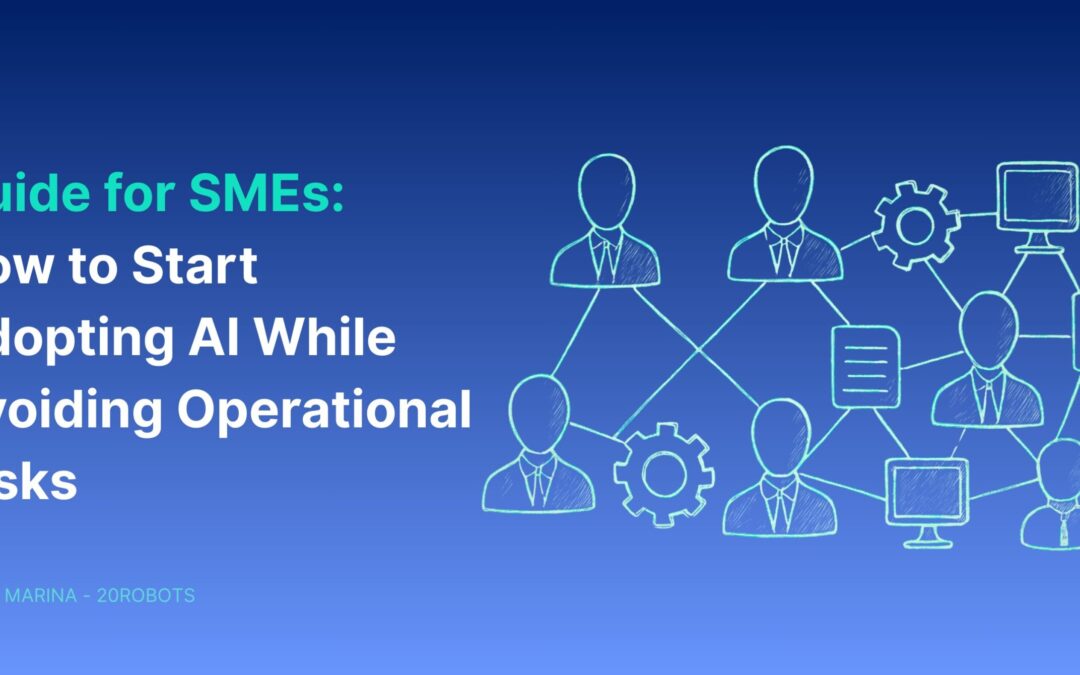
From “Digital Islands” to a Connected System
Once processes are clarified, the next step is to understand where information resides and how it moves between departments and teams. In many SMEs, data exists but is dispersed: sales data in a CRM, operational data in an Excel spreadsheet, and customer feedback in emails or other disconnected tools.
In this context, implementing AI as an isolated solution becomes a strategic error. A sales forecasting algorithm, no matter how advanced, will yield poor results if it lacks access to supply chain data, actual delivery capacity, or shifts in customer behavior.
While Large Language Models (LLMs) can work with unstructured data to help bridge these “islands,” using them in operational contexts requires experience, either from within the organization or through external support. Otherwise, AI risks becoming just an additional layer over fragmentation rather than its solution.
A healthy approach involves looking at the big picture and moving from separate tools to a way of working where data flows coherently between processes. AI should not be a separate point where someone ‘goes’ for answers, but rather an integrated component within the workflow that connects relevant information from across the entire organization.
When AI is built upon a common source of truth, it ceases to be a one-off experiment and becomes a genuine asset. The benefit is not just speed, but the organization’s ability to make decisions based on the complete business context, rather than on fragments of information.
Where to Start
Once processes are clarified and there is a clear picture of how work and data should flow within the organization, the natural question arises: where do we actually begin?
For an SME, a healthy start is not a massive project, but a controlled step. A carefully chosen pilot project solves a real problem without affecting the rest of the operations. The goal is not to demonstrate what AI “knows,” but to test if its integration brings value to a specific context.
Typically, the best starting points are repetitive, well-defined processes with clear rules and limited impact in case of error. Where volume is constant and steps are predictable, a pilot provides rapid learning without creating dependencies elsewhere.
Even when starting locally, the pilot must be viewed as part of a larger, future workflow that will be expanded later. Questions regarding what data is used, who consumes the output, and what happens when exceptions arise must be clarified from the very beginning.
A well-chosen pilot does not destabilize the organization. On the contrary, it builds trust, aligns teams, and provides a solid starting point for the next steps.
The Often Ignored Link: Who Holds the Process Map?
AI adoption requires, above all else, clear responsibility over the workflow that extends beyond departmental boundaries. It is not about a new technical role, but about the person who understands the process from end to end and has the authority to align the teams.
In SMEs, this role often falls to the entrepreneur or a key manager. This person is the ‘architect’ who decides who does what, which data is prioritized, and how automation links to the work of others. Without this coordination, AI remains an isolated implementation, and operational risks do not disappear; they simply migrate from one area of the company to another.
In the end, it is not the technology that makes the difference, but the vision and coordination of the person who holds the map. Artificial Intelligence can accelerate execution, but direction remains a human responsibility.
Culture: The Immune System of Transformation
Process architecture is only half the equation; the other half is organizational culture. In many cases, the real barriers to AI adoption are human, not technical. Fear of losing control or resistance to change can block initiatives that are technically perfect.
For SMEs, this aspect is even more important as teams are small, and the impact of any change is felt immediately. Automation that is not understood or accepted by people ends up becoming a source of frustration rather than efficiency. Therefore, AI adoption must be accompanied by dialogue, clarity, and involvement, not just implementation.
Efficiency does not mean moving work from humans to machines, but rethinking how humans and technology work together. In a healthy culture, AI is perceived as a partner that takes over repetitive tasks, freeing up time for high-value activities: decisions, relationships, and strategic thinking.
A healthy culture is one where people feel safe to say that a step no longer makes sense, to flag bottlenecks, and to contribute to adjusting processes, without fear of losing their relevance.
In such organizations, AI is not perceived as a threat or a control tool, but as a partner that takes over repetitive tasks and frees up time for higher-value activities: decision-making, relationship-building, and strategic thinking. This relationship of trust is, ultimately, the mechanism that protects the organization from operational risks and allows the transformation to settle naturally into everyday work.
From Intention to Healthy Adoption
AI adoption is not an exercise in speed, nor is it a competition between technologies. For SMEs, it is a process of balancing the desire to become more efficient with the need to protect day-to-day operations.
A healthy adoption begins with clearly understood processes, continues with data flowing between teams, and advances through small, controlled steps. The pilot is not a shortcut, but a mechanism for learning and control, and the role of the ‘process architect’ is essential from the very beginning.
Without this foundation, AI risks accelerating the exact things that slow an organization down. Isolated automations can create the impression of progress, but without a clear direction, they merely shift risks from one area to another.
Ultimately, technology is just a tool. The difference is made by people, the clarity of decisions, and how change is integrated into everyday work. When these elements are aligned, AI becomes a genuine support system, not a source of risk.

Cluj IT will not be liable for any false, inaccurate, inappropriate or incomplete information presented, as the authors are free to choose their approach and relevant topics, within the general guidelines of the newsletter. The opinions expressed by the authors and those providing comments are theirs alone, and do not reflect the opinions of Cluj IT.
Certain links in the articles or comments may lead to external websites. Cluj IT accepts no liability in respect of materials, products or services available on any external website which is not under the control of Cluj IT.


