
The European Digital Identity Wallet (EUDIW) gives every EU citizen a single mobile application to prove their identity, share verified credentials, and sign documents with legal validity, controlling exactly what they share and with whom, across public and private services in all European Union member states.
Cloud Signature Consortium Interoperability Tests: from standards to working technology
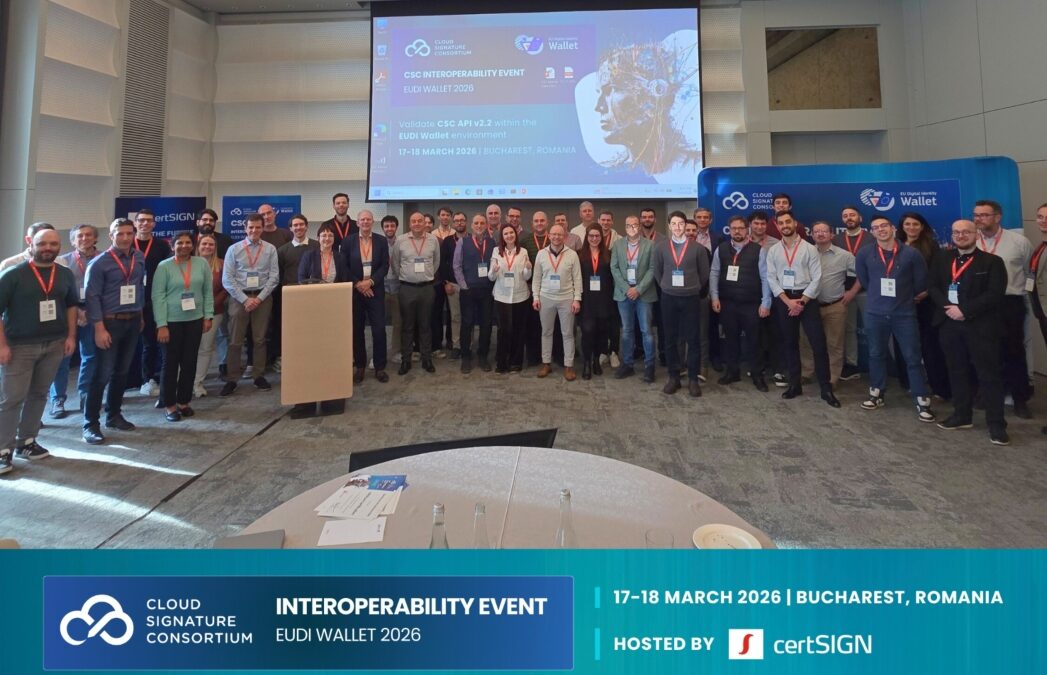
On March 17–18, 2026, Bucharest hosted the CSC Interoperability Event EUDI Wallet 2026, organized by the Cloud Signature Consortium (CSC) with the support of certSIGN[1]. The tests involved 13 organisations from the European digital identity ecosystem, from wallet providers to certification authorities, and technology developers from across the European Union.
For two days, 44 interoperability tests were performed, of which 36 were successfully completed.
A central element of the system is the qualified electronic signature, which has the same legal value as a handwritten signature and is recognized across all Member States [2]. The electronic signature is integrated into the EUDIW through the CSC API v2.2 standard, which was tested during the interoperability exercise.
The Bucharest tests demonstrated that the technology needed to implement EUDIW is no longer experimental; the solutions tested over the two days were built on production-ready infrastructure. Organizations across the EU have been developing and refining these components through Large Scale Pilots and standardization working groups for several years.
Next steps toward EUDIW readiness
certSIGN participated with its own EUDI Wallet Sandbox – a complete infrastructure that allows building a functional EUDIW ecosystem. certSIGN’s solutions were tested to ensure proper communication with systems developed by other European companies, demonstrating that Romania’s trusted infrastructure is compatible and ready for the European ecosystem.
The certSIGN EUDIW Sandbox [3] is available not only for certSIGN’s own development, but also for companies and public institutions starting to prepare their systems for EUDIW adoption, whether they will be relying parties, authentic sources, or both. It provides a complete environment for all EUDIW legal obligations: wallet applications, Personal Identification Data (PID) issuance and usage, Qualified) Electronic Attestation of Attributes ((Q)EAA) issuance and verification, Strong Customer Authentication (SCA) flows, qualified electronic signatures using CSC API, and trust services, allowing organisations to validate compliance readiness in a safe, isolated environment without any production risk.
Beyond compliance, organisations that understand the EUDIW ecosystem early will be positioned to offer wallet-native services ahead of the market. Faster digital onboarding, wallet-based attribute issuance, and streamlined cross-border customer journeys are turning a compliance obligation into a business opportunity.
This sandbox has already been put to practical use. Babeș-Bolyai University and certSIGN are running a real-world EUDIW pilot built on the sandbox infrastructure. It is covering student onboarding, issuance of verifiable academic credentials, integration of authoritative data sources. This shows that organisations that start now can have a working implementation well ahead of the mandatory deadlines, with time to refine and adapt.
What is EUDIW
For most users, interacting with a bank, a public institution, or an employer still means paperwork, physical presence, and repeated identity checks. The European Digital Identity Wallet (EUDIW) is the European’s Union framework to change this.
Under the revised eIDAS Regulation (Regulation 2024/1183), every EU Member State must provide citizens with a digital identity wallet. This is a mobile application that securely stores personal identification data, verified credentials such as diplomas or professional qualifications, and enables strong authentication and qualified electronic signatures. The wallet gives users control over what they share: you can prove you are over 18 without revealing your date of birth, or confirm your professional status without disclosing your full identity. This selective disclosure is one of the features that sets EUDIW apart from existing digital identity solutions.
For organizations, EUDIW works in two directions.
- Relying parties: they can verify the identity of their customers through the wallet instead of manual checks.
- Authentic sources: they can issue trusted credentials directly into citizens’ wallets: a bank can certify an IBAN, a university can confirm a degree, a public authority can attest a professional license.
The same institution can be both a relying party and an authentic source, often within the same customer journey.
Implementation timeline
The legal deadlines for the adoption of EUDIW are binding. By December 2026, wallets must be available to all EU citizens. By July 2027, organizations subject to Anti Money Laundering (AML) Regulation must use eIDAS-compliant identity verification methods. By December 2027, banks, telecoms, health, education, and other regulated sectors must integrate the EUDIW in their business processes.
If EUDIW is on your agenda, you can follow certSIGN’s dedicated EUDIW newsletter on LinkedIn covering regulatory updates, technical developments, and practical guidance as the ecosystem evolves [4].
[4] https://www.linkedin.com/newsletters/eudi-wallet-facts-tips-7435339063555117057/



